Tips from Amanda, our self storage expert
Packing a self storage unit well means you fit more into less space, protect your belongings from damage and find what you need quickly when you return. The short answer is to plan your layout first, pack items securely in strong boxes, place the largest and least-used items at the back and keep a clear path to everything you may need.
We asked Amanda, our self storage expert, to share her step-by-step advice for 2027.
Ask Amanda: What is the most common packing mistake?
Amanda says: "Not planning ahead. A little organisation before you start saves time, effort and space later. If you know what is going in and where it will sit, the whole process becomes much easier."
Step 1: Plan before you pack

Amanda says: "Make a list of everything you are storing and decide where each item will go in the unit. When you need something later, you will know exactly where it is."
- Measure larger items such as sofas, wardrobes and beds so you can choose the right unit size.
- Draw a simple layout of your unit showing where each group of items will sit.
- Keep a written or digital record of every box. Our guide on how to create a storage unit inventory shows you how.
Step 2: Gather the right packing materials
Amanda says: "Good materials make the biggest difference. Strong boxes stack safely and protect what is inside."
- Sturdy double-walled boxes in a few standard sizes so they stack evenly
- Packing paper and bubble wrap for fragile items
- Wardrobe cartons for clothes on hangers
- Mattress and sofa covers to keep soft furnishings clean and dry
- Strong tape and a marker pen for labelling
You can buy boxes and packing materials from the Pickfords Eco Box Shop, online or in store at our facilities.
Step 3: Pack each item carefully
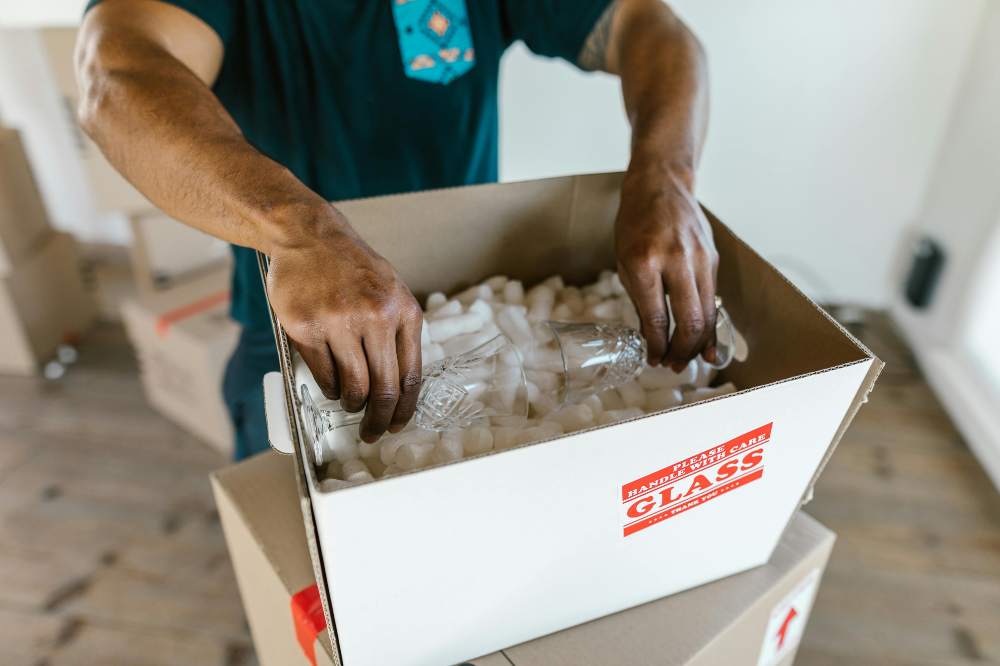
Amanda says: "Wrap items individually and fill every gap in a box so nothing moves around."
- China and glassware: wrap each piece in packing paper, then bubble wrap. Stand plates on their edges for extra strength.
- Lamps: remove bulbs, wrap the base and pack the shade separately.
- Clothing: clean everything first and use wardrobe cartons for hanging items.
- Furniture: take apart bed frames and tables, keep screws in labelled bags and wrap wooden surfaces to prevent scratches.
- Electronics: use original packaging where possible, or wrap in bubble wrap and pack tightly.
- Books and documents: use smaller boxes so they do not become too heavy to lift.
Make sure everything is clean and completely dry before it goes into storage to prevent damp and mould.
Step 4: Load your unit in the right order
Amanda says: "Think of your unit in layers. Heavy and rarely used items go in first, at the back and on the bottom."
- Place large furniture and appliances along the back wall.
- Stand mattresses and sofa cushions upright against the side walls.
- Stack heavy boxes at the bottom and lighter boxes on top.
- Leave a central walkway so you can reach items at the back.
- Put the things you will need most often near the front.
Pro tip from Amanda: "Never stack heavy items on soft furnishings. It is tempting, but it can damage sofas and chairs."
Step 5: Make the most of the space
Amanda says: "Think vertical. Using the full height of the unit can mean the difference between a 50 sq ft and a 100 sq ft unit, and that has a direct effect on what you pay."
- Use boxes of the same size so they stack neatly and safely.
- Fill hollow spaces, such as drawers and wardrobes, with smaller items or linen.
- Leave a small gap between your items and the walls so air can circulate.
- Label every box on the top and at least one side.
Step 6: Check before you leave
Amanda says: "Step back and look at everything once it is in. Can you still reach what you need? Are fragile items safe and nothing is leaning? A quick check now saves problems later."
What not to pack
Some items cannot go into a self storage unit, including perishable food, flammable or hazardous materials, illegal items and anything living. Read our full guide to things you should not put in a self storage unit before you start.
Frequently asked questions
- How do you pack a storage unit efficiently?
Plan your layout, use boxes of the same size, place heavy and rarely used items at the back, use the full height of the unit and leave a walkway to the back.
- Should furniture be wrapped in self storage?
Yes. Wrap wooden surfaces and cover upholstered furniture and mattresses to protect them from dust and scuffs. Avoid sealing items in plastic for long periods so moisture is not trapped.
Yes. Pickfords offers professional packing and collection services. Free collection is available for drive-up storage and containers in Edinburgh, Horsham and Manchester. Visit our additional services page to find out more.
Amanda says: "With a little planning and the right materials, your belongings stay safe and you make the most of every square foot of your unit."
Need more advice? Contact your local Pickfords Self Storage facility or explore our self storage options to find the right unit for you.