Business document storage
Document self storage gives you a secure, organised home for paperwork you must keep but rarely need. The key is knowing what to keep and for how long, packing it so it stays in good condition and indexing it so any file can be found in minutes. This applies equally to household records and business archives.
This guide covers retention periods, how to prepare and label paperwork and how to arrange documents in a self storage unit.

How long should you keep documents?
The table below summarises common UK guidance. Rules can change, so check GOV.UK or speak to your accountant before you destroy anything.
Type of record | General guidance |
Self Assessment records (not self-employed) | At least 22 months after the end of the tax year the return covers |
Self-employed business records | At least 5 years after the 31 January submission deadline for the tax year |
Limited company records | At least 6 years from the end of the last company financial year they relate to |
Payslips and P60s | Keep until you are sure your tax and pension records are correct |
Pension statements | Keep until you have retired and your pension is in payment |
Property documents | Keep for as long as you own the property |
Wills | Store the original with your solicitor or in a safe place, and tell your executors where it is |
What to keep at home and what to store
Keep at home or with your solicitor | Suitable for self storage |
Passports and driving licences | Older tax returns and supporting records |
Birth, marriage and death certificates | Bank and utility statements from previous years |
Original wills and powers of attorney | Closed business accounts and invoices |
Current year's financial paperwork | Archived client and project files |
Anything you may need at short notice | Family papers, letters and photographs |
How to prepare documents for storage
- Sort by type and year. Group records into categories such as "Tax", "Bank" and "Property", then by year.
- Remove duplicates and shred what you no longer need. Use a cross-cut shredder or a confidential waste service for anything containing personal or financial details.
- Remove metal paper clips and bulldog clips. Metal can rust and mark paper over time. Use plastic clips or folders instead.
- Use acid-free folders for important originals and photographs, which helps prevent yellowing.
- Pack into sturdy archive boxes with lids. Uniform boxes stack safely and keep dust out. You can order boxes from our Box Shop.
- Keep each box light enough to lift comfortably. Overfilled boxes split and are harder to move.
Label every box

A clear label on two sides of each box saves time later. Include:
- a box number
- the category, such as "Tax returns"
- the date range, such as "April 2019 to March 2021"
- a destroy-by date, if the records have a retention period
For example: "Box 14. Tax returns. April 2019 to March 2021. Destroy after January 2027." A destroy-by date makes your yearly review quick, as you can remove expired boxes without opening them.
Create an index
Keep a simple spreadsheet or list with the box number, category, date range, destroy-by date and location in the unit. Store a copy at home and a digital copy somewhere safe. Our guide to creating a storage unit inventory shows you how.
Should you scan your documents?
Scanning makes records easy to search and gives you a backup. HMRC generally accepts digital copies of records, but some originals, such as wills, deeds and certain legal documents, should always be kept in paper form. Check with your accountant or solicitor before destroying any originals.
Arranging documents in your unit
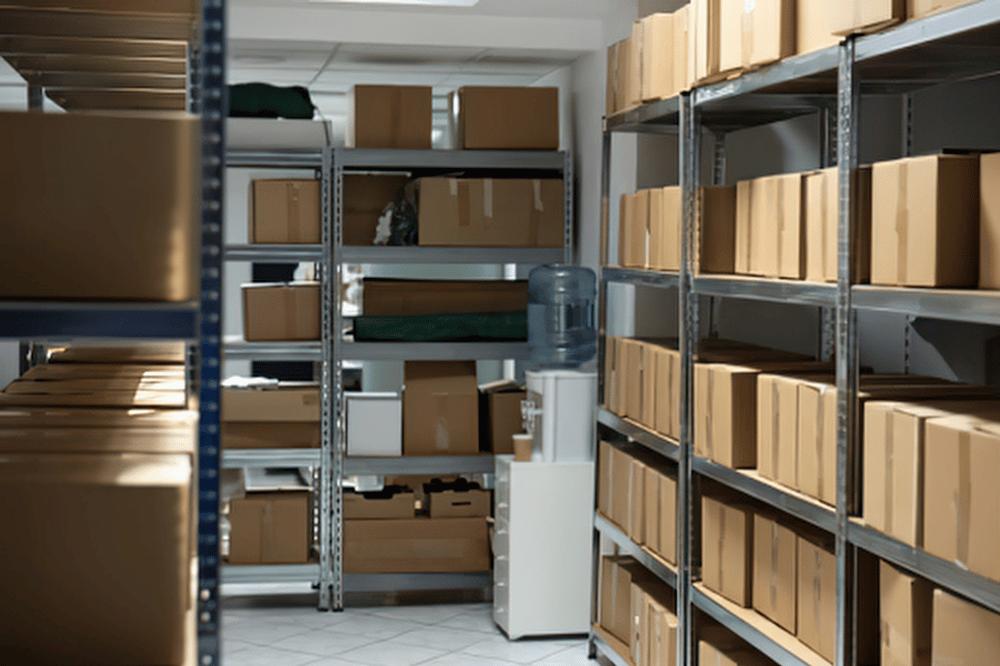
- Use freestanding shelving or pallets to keep boxes off the floor.
- Store boxes in number order, with the newest or most used at the front.
- Avoid stacking boxes so high that the bottom ones are crushed.
- Turn labels to face outwards.
- Keep a clear walkway between rows.
For more loading tips, read how to pack a self storage unit.
Business document storage
Paper archives take up valuable office space. Business document storage gives you a dedicated area for records at a predictable monthly cost, with flexible terms as your needs change.
Document storage solutions for business work best with clear rules from the start:
- Appoint one person to manage the index and access to the unit.
- Agree a naming system for boxes across all departments.
- Record when each box goes in and comes out.
- Review once a year and securely destroy records past their retention date.
If your records contain personal data about customers, staff or clients, UK GDPR applies. The Information Commissioner's Office (ICO) expects personal data to be kept secure and for no longer than necessary, so keep access limited and dispose of expired records securely.
Find out more in our guide to business self storage. If you run a business from home, read how self storage can help a home-based business grow.
Choosing the right unit
A small unit can hold a large number of archive boxes when shelving is used. Our guide to self storage unit sizes can help you estimate the space you need. For long-term archive storage, drive-up self storage is a practical option. If you retrieve files regularly, container storage and traditional self storage offer quick access.
Choose a secure facility to keep your belongings safe at all times. Many Pickfords facilities offer 24/7 access, so you can retrieve a file when you need it.
Clearing a relative's paperwork
If you are sorting the papers of a relative, keep everything until the executor confirms what is needed for the estate. Our guide to house clearance explains what to look for first.
Document storage checklist
- Check retention periods before you destroy anything
- Keep originals you may need at short notice at home
- Sort by category and year
- Remove metal clips and shred duplicates securely
- Use archive boxes with lids
- Label each box with a number, date range and destroy-by date
- Keep an index at home and in digital form
- Review once a year
Frequently asked questions
- Is it safe to store documents in a self storage unit?
Yes, when they are packed in sturdy boxes with lids, raised off the floor and kept in a secure facility.
- How long should I keep my tax records?
If you are self-employed, keep records for at least 5 years after the 31 January submission deadline for the tax year. Other Self Assessment records should be kept for at least 22 months after the end of the tax year. Check GOV.UK for the latest guidance.
- How long must a limited company keep records?
Generally at least 6 years from the end of the last company financial year they relate to.
- How do I find a file quickly in storage?
Number every box, label it with the category and date range and keep an index of what each box holds.
- How much does document storage cost?
Self storage at Pickfords starts from £18 a month including VAT. The cost depends on the unit size, location and length of stay.
Store your documents with Pickfords
Whether you are clearing household paperwork or archiving business records, Pickfords has a storage solution to suit you. Explore our business storage options, or contact Pickfords today to discuss your storage needs.